4. Array & String Techniques
🪟 The moves that turn O(n²) into O(n): two pointers, sliding window, prefix sums, intervals, bit tricks.
The unifying idea. Every technique here replaces re-examining the whole array on every step with maintaining a claim about the current state — an invariant — and updating it in \(O(1)\) per step. Name the invariant and you can both trust the algorithm and often derive the code from it.
A. Two pointers
Why · \(O(n)\) with \(O(1)\) space for problems with a two-ended structure. Where · “find a pair,” “compare ends,” “shrink from both sides” — the upcoming pattern-triggers post trigger row.
Trigger: two quantities are at either end of a sorted array or string, and moving one end is always the right choice.
Invariant: if an answer exists, it lies within the index range [left, right] — so advancing
the pointer that cannot improve the answer never misses a solution.
Example problem: given an array of wall heights, find the two walls that enclose the maximum water area.
Algorithm:
heights = [1, 8, 3, 7]
left, right = 0, len(heights) - 1
best = 0
while left < right:
    area = min(heights[left], heights[right]) * (right - left)
    best = max(best, area)
    if heights[left] <= heights[right]:  # shorter wall limits area — move it
        left += 1
    else:
        right -= 1
# The formula and the if-condition change per problem; the while-loop structure stays.
Figure 1 · Two pointers converging: move the shorter wall.
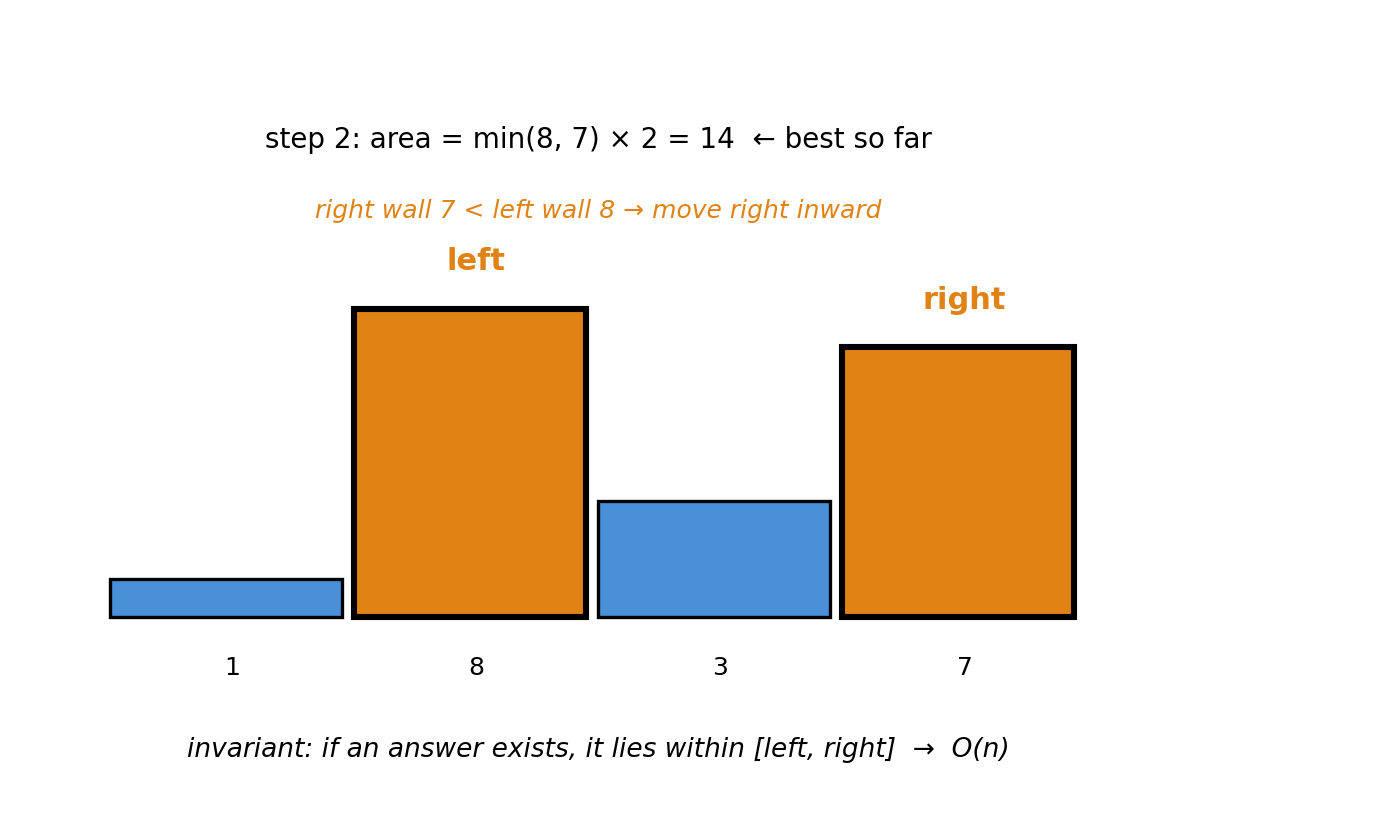
The shorter wall limits the area — moving it is the only step that could possibly find something better, so the invariant is preserved.
Mechanism trace — Container With Most Water, heights = [1, 8, 3, 7]:
- left = 1, right = 7: area = 1 × 3 = 3. Left shorter → move left inward.
- left = 8, right = 7: area = 7 × 2 = 14. Right shorter → move right inward.
- left = 8, right = 3: area = 3 × 1 = 3. Converged. Best = 14.
Each step is \(O(1)\); at most \(n\) steps → O(n) total.
Variant — fast/slow pointer (Floyd’s cycle): fast moves 2 steps, slow moves 1; they meet if and only if a cycle exists. Lives on Graphs.
Costs: \(O(n)\) time · \(O(1)\) space.
B. Sliding window
Why · \(O(n)\) for any “longest/shortest subarray satisfying a constraint” problem. Where · substrings, subarrays, rate-limiting windows in streaming data (the upcoming DSA-at-work post).
Trigger: “longest/shortest subarray or substring satisfying a constraint.”
Invariant: the window [left, right] always satisfies the constraint. On each step: expand right (add
one element); if the constraint breaks, shrink left until it holds again.
Example problem: given a string, find the longest substring with no repeated character.
Algorithm:
seen = {}   # tracks last index of each character
left = 0
best = 0
for right, char in enumerate(a):
    if char in seen and seen[char] >= left:  # char is already in the window
        left = seen[char] + 1               # shrink: move left past the duplicate
    seen[char] = right
    best = max(best, right - left + 1)       # window [left..right] has no repeats
Figure 2 · Sliding window expanding and shrinking.
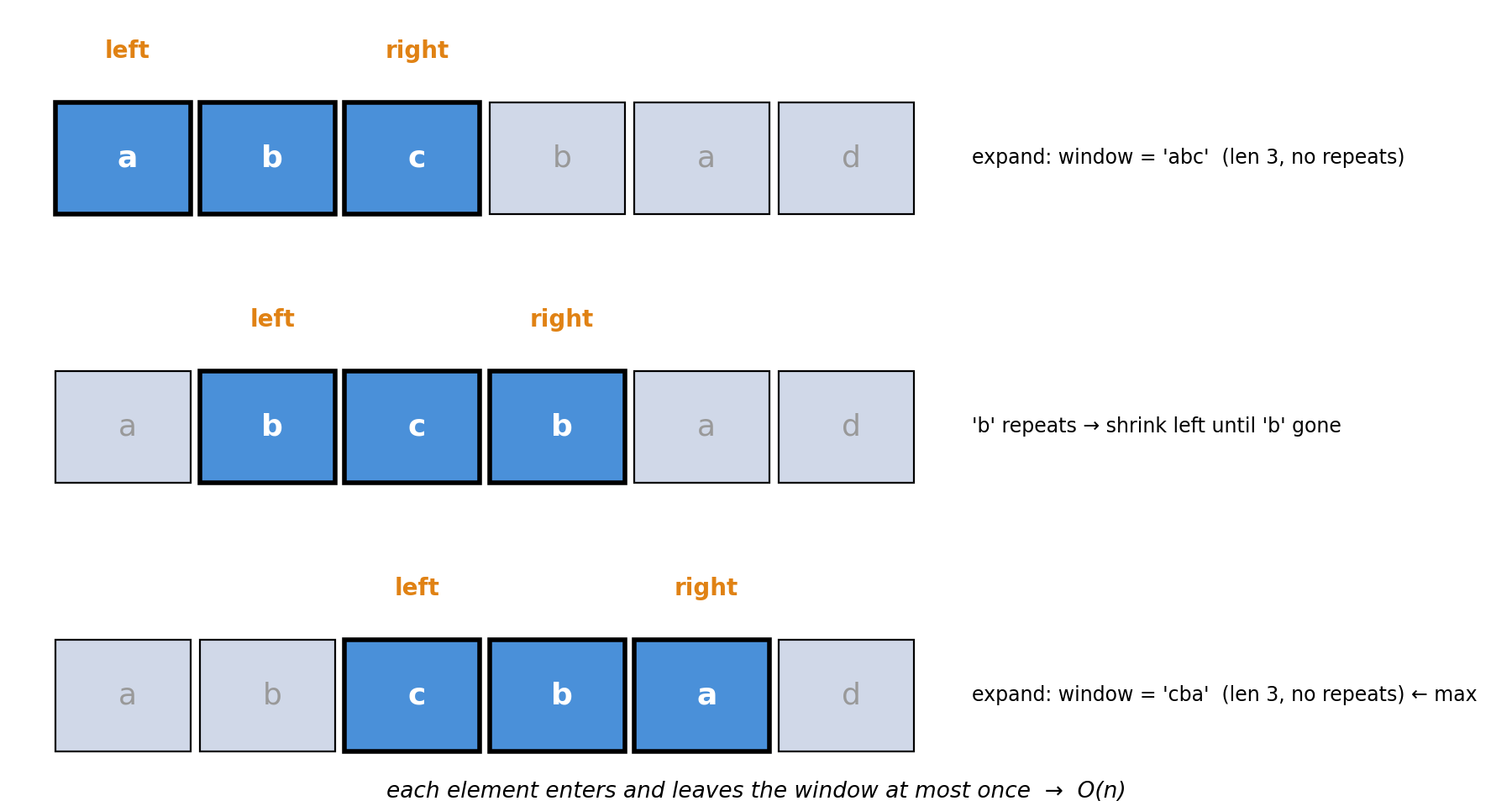
Each row is one state. The window (blue) expands right until a repeat forces a left shrink, then expands again. Each element enters and leaves at most once.
Mechanism trace — longest substring without repeating characters, s = "abcbad":
| right | char | action | window | len |
|---|---|---|---|---|
| 0 | a |
expand | "a" |
1 |
| 1 | b |
expand | "ab" |
2 |
| 2 | c |
expand | "abc" |
3 |
| 3 | b |
repeat → shrink left to 2 | "cb" |
2 |
| 4 | a |
expand | "cba" |
3 |
| 5 | d |
expand | "cbad" |
4 ← answer |
Costs: \(O(n)\) — each element enters and leaves the window at most once.
C. Prefix / suffix sums
Why · \(O(1)\) per range query after an \(O(n)\) build — the same idea powers the “product except self” trick. Where · repeated range aggregates, cumulative statistics, “product of all except self.”
Trigger: “answer a range sum/product query many times” or “need aggregate of all elements except position \(i\).”
Invariant: prefix[i] = aggregate of a[0..i-1]. Range query [start, end] =
prefix[end+1] - prefix[start] — one subtraction, no scan.
Example problem: given an array, answer many “sum of elements from index start to end” queries in O(1) each.
Algorithm:
a = [3, 1, 4, 1, 5, 9]
n = len(a)

# Build prefix array — O(n)
prefix = [0] * (n + 1)
for i in range(n):
    prefix[i + 1] = prefix[i] + a[i]   # prefix[i] = sum of a[0..i-1]

# Answer any range query — O(1)
def range_sum(start, end):
    return prefix[end + 1] - prefix[start]   # sum of a[start..end]

range_sum(2, 5)   # → 19  (= 4+1+5+9)
Figure 3 · Prefix array and O(1) range query.
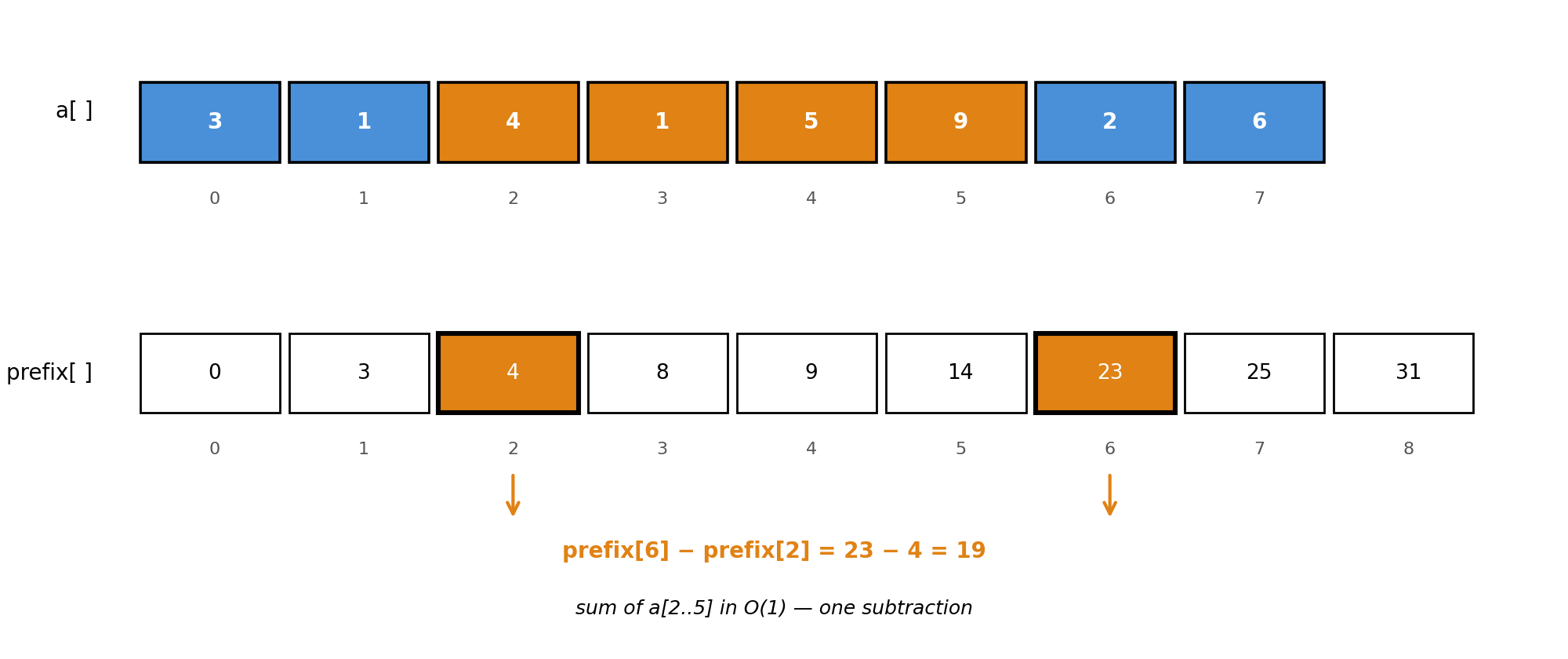
Top row: original values (orange = queried range). Bottom row: prefix sums. The query resolves to one subtraction between two highlighted prefix cells.
Mechanism trace — a = [3, 1, 4, 1, 5, 9], query sum of a[2..5]:
Build the prefix array once, then answer in O(1):
| i | a[i] | prefix[i+1] = prefix[i] + a[i] |
|---|---|---|
| 0 | 3 | 3 |
| 1 | 1 | 4 |
| 2 | 4 | 8 |
| 3 | 1 | 9 |
| 4 | 5 | 14 |
| 5 | 9 | 23 |
range_sum(2, 5) = prefix[6] - prefix[2] = 23 - 4 = 19 = 4+1+5+9 ✓
Variant — Product of Array Except Self. Run prefix products left-to-right and suffix products
right-to-left; result[i] = prefix[i] × suffix[i]. O(n), no division needed.
Costs: \(O(n)\) build — one pass to fill the prefix array · \(O(1)\) per query — one subtraction.
D. Merge intervals
Why · \(O(n \log n)\) to merge all overlapping spans in one sorted sweep. Where · calendar/booking systems, sessionization, rate-limit windows (the upcoming DSA-at-work post).
Trigger: “merge overlapping ranges,” “find gaps,” “detect conflicts in time spans.”
Invariant: sort by start; the current interval overlaps the last merged one if and only if
curr.start ≤ last.end. If it does, extend last.end; otherwise start a new merged span.
Example problem: given a list of time intervals, merge all overlapping ones.
Algorithm:
intervals = [[1, 3], [2, 6], [8, 10]]
intervals.sort(key=lambda interval: interval[0])   # sort by start time
merged = [intervals[0]]
for start, end in intervals[1:]:
    if start <= merged[-1][1]:                     # overlaps last merged span
        merged[-1][1] = max(merged[-1][1], end)    # extend it
    else:
        merged.append([start, end])                # disjoint: start a new span
# merged → [[1, 6], [8, 10]]
Figure 4 · Merge intervals: before and after.
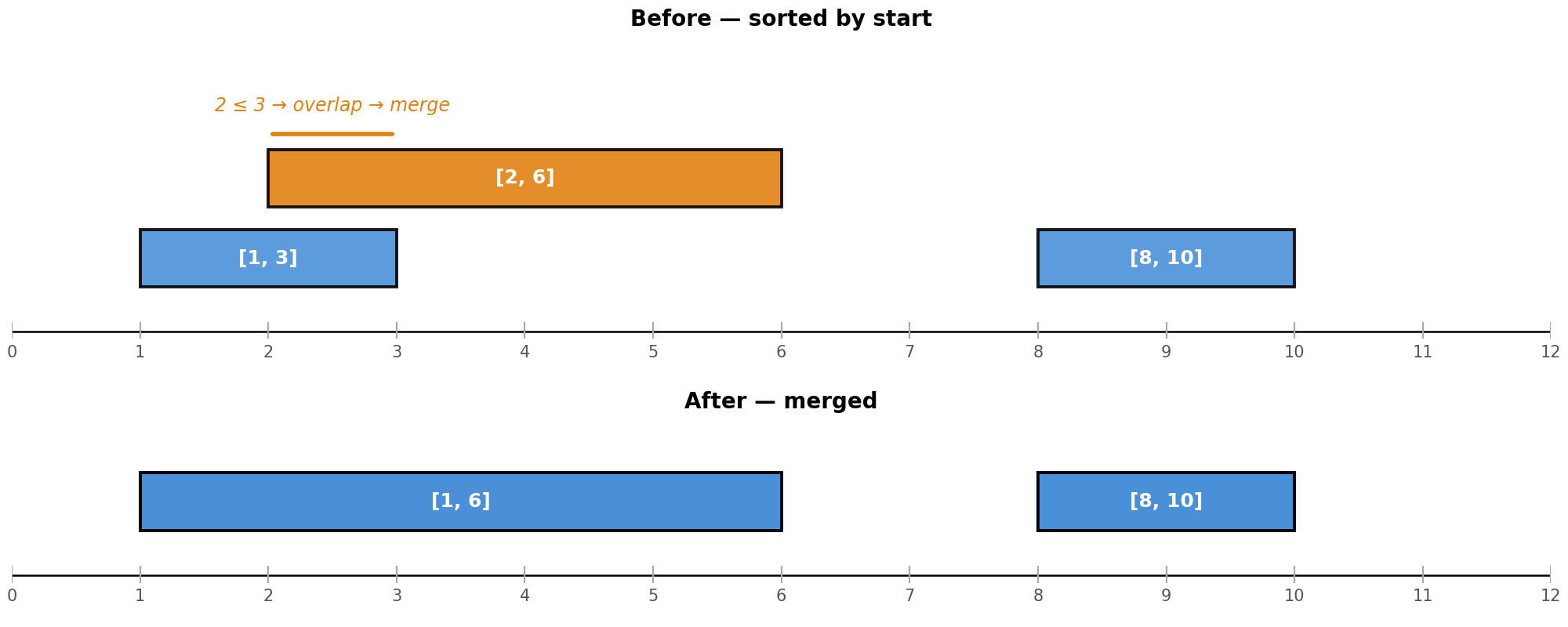
Top: original intervals, orange pair overlaps. Bottom: merged result — overlapping spans combined, disjoint spans kept separate.
Mechanism trace — [[1,3],[2,6],[8,10]]:
-
intervals.sort(key=lambda x: x[0])→[[1,3],[2,6],[8,10]]. - Start with
[1,3]. Next[2,6]: \(2 \leq 3\) → overlap → extend to[1,6]. - Next
[8,10]: \(8 > 6\) → no overlap → append. Result:[[1,6],[8,10]].
Costs: \(O(n \log n)\) (sort dominates) · \(O(n)\) space.
E. Bit tricks
Why · \(O(1)\) per operation for problems involving counting bits, pairing, or set membership. Where · duplicate detection, bitmasked state, performance-critical loops.
Trigger: “find the element without a pair,” “count set bits,” “check if a number is a power of two.”
Bit basics (everything below follows from these):
- A number is stored as binary digits. Each position \(i\) (from right, starting at 0) has weight \(2^i\). So \(6 = 110_2 = 1{\cdot}2^2 + 1{\cdot}2^1 + 0{\cdot}2^0 = 4+2+0\) and \(5 = 101_2 = 1{\cdot}2^2 + 0{\cdot}2^1 + 1{\cdot}2^0 = 4+0+1\).
-
AND (
&): bit is 1 only if both inputs are 1.0b110 & 0b101 = 0b100(=4). -
OR (
|): bit is 1 if either input is 1.0b110 | 0b101 = 0b111(=7). -
XOR (
^): bit is 1 if inputs differ.0b110 ^ 0b101 = 0b011(=3). Same bits cancel:x ^ x = 0. -
-xin binary (two’s complement): to negate a number, flip all bits then add 1. Step by step for \(x = 6\):0110(start) →1001(flip all bits) →1010(add 1) = \(-6\). Compare: \(x = \mathtt{0110}\), \(-x = \mathtt{1010}\) — bit 1 (value 2) is set in both. The lowest set bit always survives negation. That is whyx & (-x)isolates it.
Trick 1 — XOR: identical values cancel. Follows directly from the XOR definition above: x ^ x = 0
and x ^ 0 = x, so every pair cancels and only the unique value survives.
nums = [2, 3, 2, 5, 5]   # every value appears twice except 3
result = 0
for v in nums:
    result ^= v   # pairs cancel; singleton survives
# result → 3
Trace: 0^2=2 → 2^3=1 → 1^2=3 → 3^5=6 → 6^5=3 ✓
Cost: \(O(n)\) time · \(O(1)\) space.
Trick 2 — x & (x-1) clears the lowest set bit. Subtracting 1 from x flips the lowest set bit
and all bits below it (borrow chain in binary); AND with the original keeps only the bits above it.
Figure 5 · x & (x−1): how subtracting 1 flips the lowest set bit.
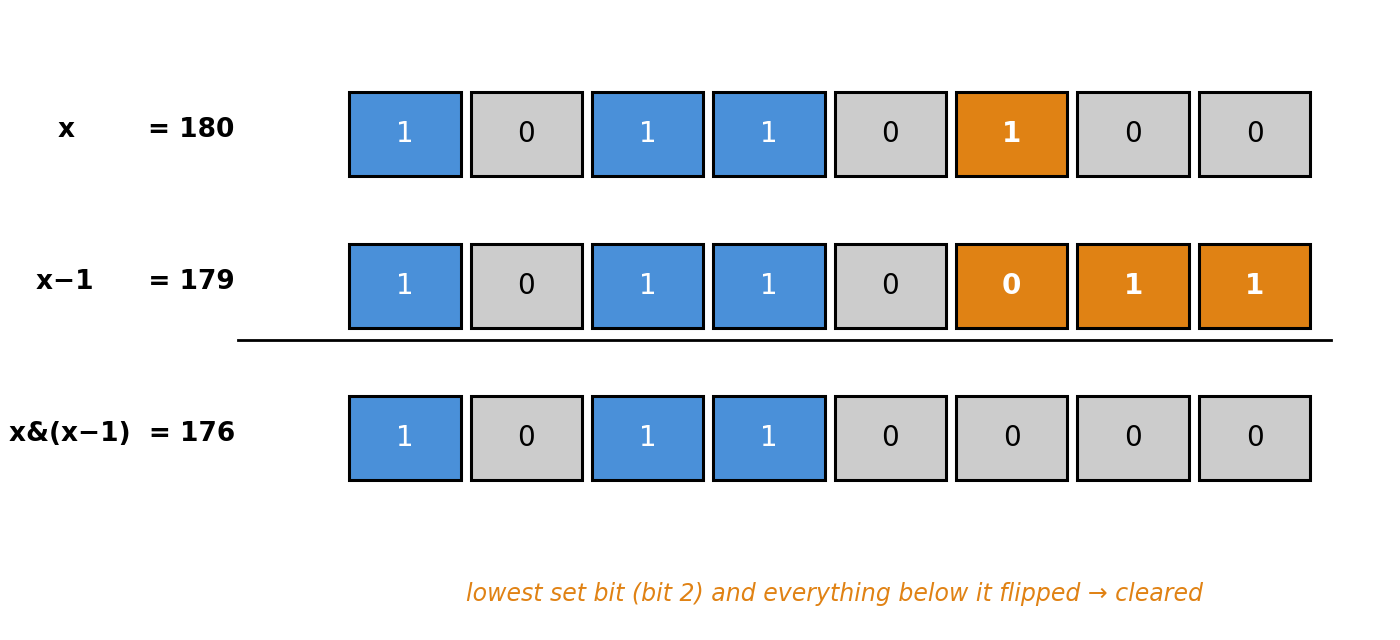
Three rows: x, x−1, and x&(x−1). The orange bit (lowest set bit) and everything below it flip in x−1; AND with x clears them.
x = 0b10110100   # 180: has 4 set bits
count = 0
while x:
    x &= x - 1   # clear one set bit per iteration
    count += 1   # count = 4 after the loop
# Also: x & (x-1) == 0 iff x is a power of two (only one set bit)
Cost: \(O(k)\) where \(k\) = number of set bits — faster than scanning all bits.
Trick 3 — x & (-x) isolates the lowest set bit. Negating x (flip all bits, add 1) preserves
the lowest set bit while flipping everything above it. AND keeps only the bit set in both.
Figure 6 · x & (−x): the lowest set bit survives negation.
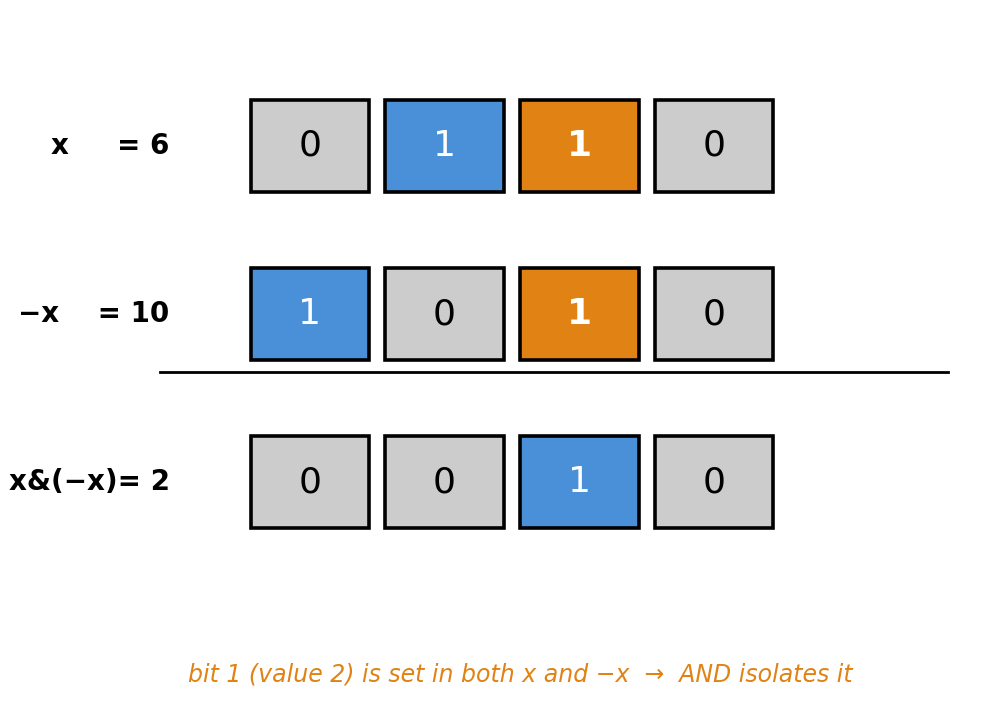
x = 6 (0110) and −x = 10 (1010) share only bit 1; AND isolates it — result = 2 (0010).
x = 6             # binary: 0110 — lowest set bit is bit 1 (value 2)
lsb = x & (-x)    # → 2  (binary: 0010)
Used in Fenwick trees (Hierarchical Structures) for index arithmetic.
Cost: \(O(1)\) — single arithmetic operation.
🔗 Connections
- Linear structures these techniques operate on: Linear Structures.
- Invariant concept (init / maintain / terminate): Sorting & Searching.
- Technique recognition triggers and work applications: the upcoming pattern-triggers post / the upcoming DSA-at-work post.
- Floyd’s cycle (fast/slow pointer variant of two pointers): Graphs.
- Fenwick tree (uses bit trick
x & (-x)): Hierarchical Structures.